
Drama
Rationale
The Arts have the capacity to engage, inspire and enrich all students, exciting the imagination and encouraging them to reach their creative and expressive potential. The term 'creativity' plays a critical role in all arts subjects. For the Western Australian Curriculum, the following explanation of the creative process is useful:
[There are] … four characteristics of creative processes. First, they always involve thinking or behaving imaginatively. Second, overall this imaginative activity is purposeful: that is, it is directed to achieving an objective. Third, these processes must generate something original. Fourth, the outcome must be of value in relation to the objective. We therefore define creativity as: Imaginative activity fashioned so as to produce outcomes that are both original and of value. Robinson, K. (1999) National Advisory Committee on Creative and Cultural Education: "All Our Futures: Creativity, Culture and Education". p. 30
The Arts learning area comprises five subjects: Dance, Drama, Media Arts, Music and Visual Arts. Together they provide opportunities for students to learn how to create, design, represent, communicate and share their imagined and conceptual ideas, emotions, observations and experiences, as they discover and interpret the world.
The Arts entertain, inform, challenge, and encourage responses, and enrich our knowledge of self, communities, world cultures and histories. The Arts contribute to the development of confident and creative individuals, nurturing and challenging active and informed citizens. Learning in the Arts is based on cognitive, affective and sensory/kinaesthetic response to arts practices as students revisit increasingly complex content, skills and processes with developing confidence and sophistication through the years of schooling.
Dance
Dance is expressive movement with purpose and form. Through Dance, students represent, question and celebrate human experience, using movement as the medium for personal, social, emotional, physical and cultural communication.
Active participation as dancers, choreographers and audiences promotes wellbeing and social inclusion. Learning in and through Dance enhances students' knowledge and understanding of diverse cultures and contexts and develops their personal, social and cultural identity.
Drama
Drama is the expression and exploration of personal, emotional, social and cultural worlds, through role and situation, that engages, entertains and challenges. Students create meaning as drama makers, performers and audiences as they engage with and analyse their own and others' stories and points of view.
In making and staging drama, they learn how to be focused, innovative and resourceful, collaborate and take on responsibilities for drama presentations. Students develop a sense of curiosity and empathy by exploring the diversity of drama in the contemporary world and in other times, traditions, places and cultures.
Media Arts
Media Arts enables students to analyse past technologies, and use existing and emerging technologies as they explore imagery, text and sound to create meaning. Students participate in, experiment with, and interpret cultures, media genres and styles, and different communication practices.
Students learn to be critically aware of ways that media are culturally used and negotiated, and are dynamic and central to the way they make sense of the world and themselves. They learn to interpret, analyse and develop media practices through their experiences in making media arts. They are inspired to imagine, collaborate and take on responsibilities in planning, designing and producing media artworks.
Music
Music has the capacity to engage, entertain, challenge, inspire and empower students. Studying music stimulates imaginative and innovative responses, critical thinking and aesthetic understanding, and encourages students to reach their creative and expressive potential.
Music exists distinctively in every culture and is a basic expression of human experience. Students' active participation in music, individually and collaboratively, draws on their own traditions and life experiences. These experiences help them to appreciate and meaningfully engage with music practices and traditions of other times, places, cultures and contexts.
Visual Arts
Visual Arts incorporates all three fields of art, craft and design. Students create visual representations that communicate, challenge and express their own and others' ideas, both as artists and audience members. They develop perceptual and conceptual understanding, critical reasoning and practical skills through exploring and expanding their understanding of their world, and other worlds.
Visual Arts engages students in a journey of discovery, experimentation and problem-solving relevant to visual perception and visual language. Students undertake this journey by utilising visual techniques, technologies, practices and processes. Visual Arts supports students' ability to recognise and develop cultural appreciation of visual arts in the past and contemporary contexts through exploring and responding to artists and their artworks.
Aims
Dance
Dance knowledge and skills ensure that, individually and collaboratively, students:
- develop confidence to become innovative and creative dancers to communicate meaning through body awareness, technical dance skills and performance skills
- apply the elements of dance and choreographic skills through group processes to create dance that communicates meaning to an audience
- develop aesthetic, artistic and cultural appreciation of dance in past and contemporary contexts as choreographers, performers and audience members
- develop respect for, and knowledge of, the diverse purposes, traditions, histories and cultures of dance by making and responding as active participants and informed audiences.
Drama
Drama knowledge and skills ensure that, individually and collaboratively, students develop:
- confidence, empathy and self-awareness to explore, depict and celebrate human experience, take risks and extend their own creativity through drama
- knowledge of how to analyse, apply and control the elements, skills, techniques, processes, conventions, forms and styles of drama in traditional and contemporary drama to engage and create meaning for audiences
- knowledge of the role of group processes and design and technology in the creative process of devising and interpreting drama to make meaning for audiences
- knowledge of traditional and contemporary drama through responding as critical and active participants and audience members.
Media Arts
Media Arts knowledge and skills ensure that, individually and collaboratively, students develop:
- confidence to participate in, experiment with, and interpret the media-rich culture and communications practices that surround them
- aesthetic knowledge developed through exploration of imagery, text and sound to express ideas, concepts and stories using effective teamwork strategies to produce media artwork
- creative and critical thinking skills to explore different perspectives in media as producers and consumers
- awareness of their active participation in local and global media cultures, including using safe media practices when publishing online materials.
Music
Music knowledge and skills ensure that, individually and collaboratively, students:
- develop the confidence to be creative, innovative, thoughtful, skilful and informed musicians
- develop skills and techniques to actively listen, analyse, improvise, compose and perform music
- interpret and apply the elements of music, engaging with a diverse array of musical experiences as performers and audience members
- develop aesthetic appreciation and respect for their own and others' music practices and traditions across different times, places, cultures and contexts.
Visual Arts
Visual Arts knowledge and skills ensure that, individually and collaboratively, students:
- demonstrate confidence, curiosity, imagination and enjoyment when engaged in visual arts making
- apply visual arts techniques, materials, processes and technologies to create artworks through the design and inquiry process
- apply visual language and critical creative thinking skills when creating and responding to artwork
- develop aesthetic, artistic and cultural appreciation of visual arts in past and contemporary contexts, both as artists and art critics.
Organisation
Content Structure
The Arts learning area comprises five subjects: Dance, Drama, Media Arts, Music and Visual Arts.
The Arts curriculum is written on the basis that all students will study at least two Arts subjects from Pre-primary to the end of Year 8. It is a requirement that students study a performance subject and a visual subject.
In Years 9 and 10 the study of the Arts is optional.
In the Arts, it is desirable that schools provide students with the opportunity to engage with all five Arts subjects across Pre-primary to Year 10.
Each of the five Arts subject is organised into two interrelated strands: Making and Responding.
Making
Making in each Arts subject engages students' cognition, imagination, senses and emotions in conceptual and practical ways and involves thinking kinaesthetically, critically and creatively. Students develop knowledge and skills to plan, produce, present, design and perform in each arts subject independently and collaboratively. Students work from an idea, an intention, particular resources, an imaginative impulse, or an external stimulus.
Part of making involves students considering their work in the Arts from a range of points of view, including that of the audience. Students reflect on the development and completion of making in the Arts.
Responding
Responding in each Arts subject involves students reflecting, analysing, interpreting and evaluating in the Arts. Students learn to appreciate and investigate the Arts through contextual study. Learning through making is interrelated with, and dependent upon, responding. Students learn by reflecting on their making and responding to the making of others. The points of view students hold, shift according to different experiences in the Arts.
Students consider the Arts' relationships with audiences. They reflect on their own experiences as audience members and begin to understand how the Arts represent ideas through expression, symbolic communication and cultural traditions and rituals. Students think about how audiences receive, debate and interpret the meanings of the Arts.
Relationships between the strands
Making and Responding are intrinsically connected. Together they provide students with knowledge and skills as practitioners, performers and audience members and develop students' skills in critical and creative thinking. As students make in the Arts, they actively respond to their developing work and the works of others; as students respond to the Arts, they draw on the knowledge and skills acquired through their experiences to inform their making.
Year level descriptions
Year level descriptions provide an overview of the key concepts addressed, along with core content being studied at that year level. They also emphasise the interrelated nature of the two strands and the expectation that planning will involve integration of content from across the strands.
For the five Arts subjects, the year level description includes forms, genres, styles, contexts, materials, practices and/or elements relevant to each Arts subject that informs approaches to teaching and learning in the Arts.
Content description
Content descriptions set out the knowledge, understanding and skills that teachers are expected to teach and students are expected to learn. They do not prescribe approaches to teaching. The core content has been written to ensure that learning is appropriately ordered and that unnecessary repetition is avoided. However, a concept or skill introduced at one year level may be revisited, strengthened and extended at later year levels as needed.
Additional content descriptions are available for teachers to incorporate in their teaching programs. Schools will determine the inclusion of additional content, taking into account learning area time allocation and school priorities.
The additional content will not be reflected in the Achievement Standard.
Achievement standards
From Pre-primary to Year 10, achievement standards indicate the quality of learning that students should typically demonstrate by a particular point in their schooling. An achievement standard describes the quality of learning (e.g. the depth of conceptual understanding and the sophistication of skills) that would indicate the student is well-placed to commence the learning required at the next level of achievement.
Glossary
A glossary is provided to support a common understanding of key terms and concepts included in the core content.
Student Diversity
The School Curriculum and Standards Authority is committed to the development of a high-quality curriculum that promotes excellence and equity in education for all Western Australian students.
All students are entitled to rigorous, relevant and engaging learning programs drawn from the Western Australian Curriculum: The Arts. Teachers take account of the range of their students' current levels of learning, strengths, goals and interests and make adjustments where necessary. The three-dimensional design of the Western Australian Curriculum, comprising learning areas, general capabilities and cross-curriculum priorities, provides teachers with flexibility to cater for the diverse needs of students across Western Australia and to personalise their learning.
Students with disability
The Disability Discrimination Act 1992 and the Disability Standards for Education 2005 require education and training service providers to support the rights of students with disability to access the curriculum on the same basis as students without disability.
Many students with disability are able to achieve educational standards commensurate with their peers, as long as the necessary adjustments are made to the way in which they are taught and to the means through which they demonstrate their learning.
In some cases, curriculum adjustments are necessary to provide equitable opportunities for students to access age-equivalent content in the Western Australian Curriculum: The Arts. Teachers can draw from content at different levels along the Pre-primary – Year 10 sequence. Teachers can also use the general capabilities learning continua in Literacy, Numeracy and Personal and social capability to adjust the focus of learning according to individual student need.
Adjustments to the practical delivery of movement-based activities will be necessary to ensure some students with a physical disability can access, participate in, and achieve on the same basis as their peers. Teachers may also need to consider adjustments to assessment of students with disability to ensure student achievement and demonstration of learning is appropriately measured.
English as an additional language or dialect
Students for whom English is an additional language or dialect (EAL/D) enter Western Australian schools at different ages and at different stages of English language learning, and have various educational backgrounds in their first languages. While many EAL/D students bring already highly developed literacy (and numeracy) skills in their own language to their learning of Standard Australian English, there are a significant number of students who are not literate in their first language, and have had little or no formal schooling.
While the aims of the Western Australian Curriculum: The Arts are the same for all students, EAL/D students must achieve these aims while simultaneously learning a new language and learning content and skills through that new language. These students may require additional time and support, along with teaching that explicitly addresses their language needs. Students who have had no formal schooling will need additional time and support in order to acquire skills for effective learning in formal settings.
Gifted and talented students
Teachers can use the Western Australian Curriculum: The Arts flexibly to meet the individual learning needs of gifted and talented students.
Teachers can enrich students' learning by providing students with opportunities to work with learning area content in more depth or breadth (e.g. using the additional content descriptions); emphasising specific aspects of the general capabilities learning continua (e.g. the higher-order cognitive skills of the critical and creative thinking capability); and/or focusing on cross-curriculum priorities. Teachers can also accelerate student learning by drawing on content from later year levels in the Western Australian Curriculum: The Arts, and/or from local, state and territory teaching and learning materials.
Ways of Teaching
The 'ways of teaching' aim to support teachers with planning for curriculum delivery across the years of school, with the teaching in each year extending learning in previous years.
The 'ways of teaching' complement the principles of teaching and learning in the Western Australian Curriculum and Assessment Outline (http://k10outline.scsa.wa.edu.au/). The principles focus on the provision of a school and class environment that is intellectually, socially and physically supportive of learning. The principles assist whole-school planning and individual classroom practice.
Making and Responding are intrinsically connected. Together they provide students with knowledge, understanding and skills as artists, performers and audience members and develop students' skills in critical and creative thinking. As students make in the Arts, they actively respond to their developing work and the works of others; as students respond in the Arts, they draw on the knowledge and skills acquired through their experience in making artworks.
Teachers have the freedom to apply aspects of the strands, Making and Responding, to plan teaching programs. Through the combination of both, teachers can provide rich opportunities to extend students' knowledge, skills and capacity to analyse and reflect. Responding occurs throughout the creative learning process.
To engage students in the Arts, teachers typically create learning experiences which:
- use all aspects of perception: sensory, emotional, cognitive, physical and relational to make learning experiential for students
- develop skills in students through modelling, coaching, practising and reflecting
- enable students to work individually and collaboratively, using flexible grouping to accommodate their needs and strengths
- encourage students to take risks and extend their ideas
- foster participation in projects in a flexible, dynamic learning environment
- provide opportunities for students to experience the Arts in live or virtual settings
- explore significant and recognisable examples of the Arts from different times and cultures to develop in students an aesthetic and cultural appreciation of the Arts.
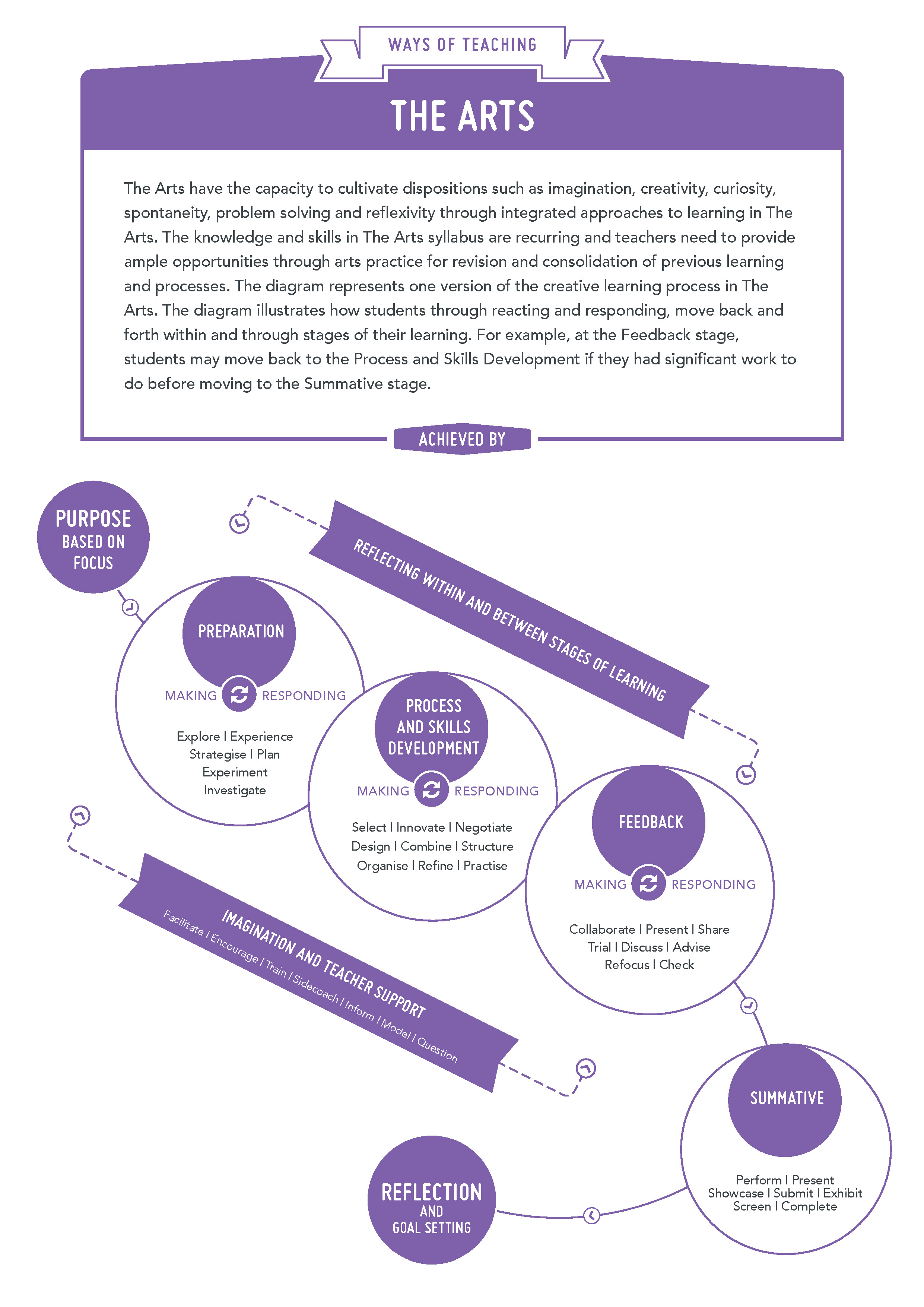
Many aspects of the Arts syllabus are recurring and teachers should provide ample opportunities through practice for revision and consolidation of previously introduced knowledge and skills. The diagram below presents one version of the creative learning process in the Arts.
Figure 1 is a visual representation of 'ways of teaching' in the Arts.
|
| Figure 1:" Ways of teaching in The Arts |
|
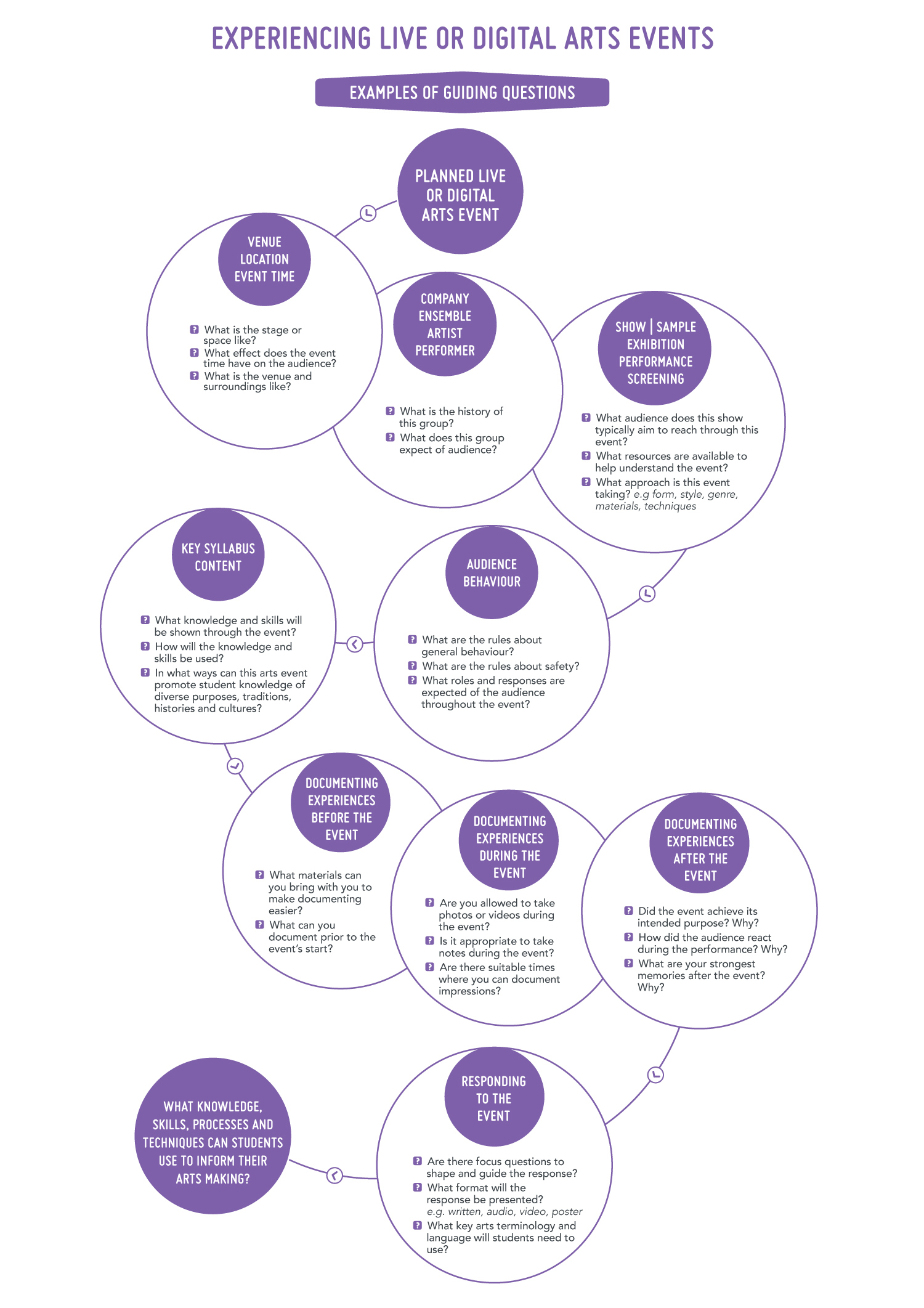
| Figure 2:" Ways of teaching in The Arts |
Safe working practices in the Arts are an essential aspect of the teaching and learning. These include providing or adapting an appropriate space to work; teaching students guiding principles to care for their voice and bodies; working safely with others and with specialist equipment; and appropriate warm-up procedures before class or a performance. Safe working practices also include the responsibility teachers and students have in the maintenance of safe social and emotional spaces for the Arts. Without this aspect of safe working practices, risk-taking becomes difficult for many students. To ensure the development of creative processes where students are willing to risk making mistakes in the Arts, teachers will need to establish and maintain a safe learning environment in the classroom.
Although Dance, Drama, Media Arts, Music, and Visual Arts are distinct subjects in the Arts, teachers may create opportunities for students to study and make artworks that feature a fusion of traditional art forms and practices to develop hybrid and/or cross-arts projects. This learning involves the exploration of traditional and contemporary arts practices, including those from different cultures that acknowledge community and cultural protocols. Such works might:
- combine performance, audio and/or visual aspects
- combine processes typical of the different Arts subjects
- involve other learning areas
- exist in physical, digital or virtual spaces
- combine traditional, contemporary and emerging media and materials
- be created individually or collaboratively.
Teachers in schools are the key to providing students with rich, sustained, rigorous learning in each of the subjects in The Arts. The Arts industry complements the provision of the Arts syllabus in schools through programs and partnerships. The industry increasingly provides specialist services for schools, as appropriate, through experiences such as visiting performances; demonstrations and exhibitions; artists in residence; professional development for teachers; and access for students and teachers to specialised facilities in galleries, concert halls, theatres and other arts venues.
Figure 2 is a visual representation of guiding questions whilst experiencing live or digital arts events.
For information on how to collect evidence to inform planning for ongoing learning experiences in the Arts, refer to 'Ways of Assessing'.
Ways of Assessing
The 'ways of assessing' complement 'ways of teaching' and aim to support teachers in developing effective assessment practices in The Arts.
The 'ways of assessing' also complement the principles of assessment contained in the Western Australian Curriculum and Assessment Outline. The assessment principles, reflective questions and assessment snapshots support teachers in reflecting on their own assessment practice in relation to each of the assessment principles. Here teachers will find:
- background information for each principle
- reflective questions
- guidance for addressing the principle within their own assessment practice.
Refer to the Western Australian Curriculum and Assessment Outline (http://k10outline.scsa.wa.edu.au) for further guidance on assessment principles, practices and phases of schooling.
The key to selecting the most appropriate assessment is in the answers to several reflective questions. For example:
- How do you use assessment as the starting point of your lesson planning?
- Do your assessments have a clear purpose?
- Do you design assessment tasks in a way that meets the dual purposes of formative and summative assessment?
- How do you use your observations of students (during the course of classroom activities, in assignments and in tests) to determine how learning can be improved?
- How do you identify students' misconceptions or gaps in their learning?
- How do you identify the next skill or understanding a student, or group of students, needs to learn?
- What information do you collect to evaluate your own teaching?
- How do you work with colleagues to evaluate student achievement data and how does this work inform your teaching?
- What range of evidence do you draw on when you report student performance and evaluate your teaching?
Refer to the Judging Standards tool in the Western Australian Curriculum and Assessment Outline (http://k10outline.scsa.wa.edu.au/home/judging-standards) when reporting
against the Achievement Standards; giving assessment feedback; or explaining the differences
between one student's achievement and another's.
In the Arts, assessment tasks typically address the syllabus content in interconnected ways within relevant, meaningful contexts to students. Assessment tasks should identify the specific applications of knowledge and skills students will use, individually and/or in groups, to achieve clear, creative goals. This provides students with opportunities to find innovative ways to solve creative challenges.
The following table provides examples of assessment strategies which can enable teachers to understand where students are in their learning. Assessments should also be based on the integration of a range of types and sources of evidence.
| Subject | Examples of assessment strategies | Examples of sources of evidence |
|---|---|---|
Dance | Movement skills: students practise planned, movement-based exercises to develop a variety of technical dance skills and performance skills. |
|
Choreographic skills: students create their own dance through completing task-based activities that engage in the use of the elements of Dance: body, energy, space and time (BEST), choreographic structures and choreographic devices. | ||
Reflective practice: students reflect, either orally or in written form, using dance terminology, on their own work and the work of others. Reflections will include analysis of the use of BEST, choreographic devices and structures, and design concepts in dance works. |
| |
Dance and contexts: students become familiar, in written or oral form, with historical, social and/or cultural contexts in which dance exists. This can be completed through investigation, where appropriate, and/or by viewing live or digital dance performances as audience members. | ||
Drama | Improvised/devised drama: based on stimuli, students engage in the development of original drama based on particular drama forms and styles and drama skills and conventions. May include the use of design and technology to support meaning. |
|
Scripted drama: based on complete scripts or script extracts (published or unpublished), students engage in the interpretation of drama texts. May include the use of design and technology to support meaning. | ||
Reflective practice: students reflect, either orally or in written form, using drama terminology and language, on their own work and the work of others and the use of the elements of drama, and design and technology in drama. |
| |
Response analysis: students respond to, in written or oral form, using drama terminology and language, the application of elements of drama to create drama forms and styles and dramatic meaning; in particular drama performances (theatre) presented to students live or via digital format. May also include discussion about the role of design and technology. | ||
Media Arts | Media production: students develop skills in all phases of media production, from pre-production and media production, to post-production. Students develop practical skills through the experience of producing in various media forms, styles and genres. |
|
Reflective practices: students reflect on their own and others', media productions using media terminology. This includes reflecting on group work and problem-solving strategies about media codes and conventions for the purpose of the production and the intended audience. |
| |
Media Arts and Contexts: students investigate, where appropriate, in oral or written form, the influence of the media, media history, and the contexts that shape the media. Points of view and values that shape productions and audience readings may also be considered. |
| |
Music | Aural and theory: students complete aural and theory tasks identifying and applying the elements of music. They develop music literacy and listening skills through practical and written activities. |
|
Composing and arranging: students complete short tasks that reinforce learning concepts, or extended works that incorporate stylistic features and conventions in structured composition activities. Students can use invented and conventional notation, appropriate music terminology and technology, working individually or collaboratively. | ||
Analysis and context: students complete aural and visual analysis tasks using scores and recordings or by listening to live performances. They identify, compare and evaluate the use of music elements, contextual and stylistic characteristics and/or cultural and historical features in a range of musical examples. |
| |
Performance: students sing and/or play instruments to reinforce an aural or theoretical principle; communicate a compositional idea; or create and/or improvise musical ideas. Performance may be a solo or ensemble activity where students practise, rehearse and refine technical and expressive skills, and develop stylistic awareness. |
| |
Visual Arts | Production: students engage in the development of a resolved artwork to develop their skills and technical abilities for the relevant chosen medium and to demonstrate their creativity and knowledge of the visual conventions. |
|
Analysis: students analyse, in written or oral form, using visual arts terminology, their own artwork and the artwork of others, based on selected frameworks. |
| |
Reflective practice: students reflect, in written or oral form, on their own artwork and the artwork of others, using the elements and principles of design, to refine and resolve artworks. | ||
Artists and contexts: students explore the social, cultural and/or historical contexts of artists through investigation, where age appropriate. |
General Capabilities
The general capabilities encompass the knowledge, skills, behaviours and dispositions that will assist students to live and work in the 21st century. Teachers may find opportunities to incorporate the capabilities into the teaching and learning program for the Arts. The general capabilities are not assessed unless they are identified within the content.
Literacy
Students become literate as they develop the knowledge, skills and dispositions to interpret and use language confidently, for learning and communicating in and out of school, and for participating effectively in society. Students use literacy when listening to, reading, viewing, speaking, writing and creating oral, print, visual and digital texts. Literacy involves students using and modifying language for different purposes in a range of contexts.
In the Arts, students use literacy along with the kinetic, symbolic, verbal and visual languages of the five Arts subjects. This enables students to develop, apply and communicate their knowledge and skills as artists and as audiences. Through making and responding, students enhance and extend their literacy skills as they create, compose, design, analyse, comprehend, discuss, interpret and evaluate their own, and others', artworks.
Each Arts subject requires students to learn and use specific terminology of increasing complexity as they move through the curriculum. Students understand that the terminologies of the Arts vary according to context and they develop their ability to use language dynamically and flexibly. They use their literacy skills to access knowledge, make meaning, express thoughts, emotions and ideas, as well as interact with, and challenge, others.
Numeracy
Students become numerate as they develop the knowledge and skills to use mathematics confidently across all learning areas at school and in their lives more broadly. Numeracy involves students recognising and understanding the role of mathematics in the world and having the dispositions and capacities to use mathematical knowledge and skills purposefully.
In the Arts, students select and use relevant numeracy knowledge and skills to plan, design, make, interpret, analyse and evaluate artworks. Across the Arts subjects, students can recognise and use numbers to calculate and estimate; spatial reasoning to solve problems involving space, patterns, symmetry, 2D and 3D shapes; scale and proportion, to show and describe positions, pathways and movements; and measurement to explore length, area, volume, capacity, time, mass and angles.
Through making and responding across the Arts, students use numeracy skills to choreograph and perform dance; build, rehearse, sequence and time plays; plan, direct and edit media texts; compose, produce and record music; and design, construct and display art. Students work with a range of numerical concepts to organise, analyse and create representations of data relevant to their own, or others', artworks, such as diagrams, charts, tables, graphs and motion capture.
Information and communication technology (ICT) capability
Students develop ICT capability as they learn to use ICT effectively and appropriately to access, create and communicate information and ideas, solve problems, and work collaboratively in all learning areas at school, and in their lives beyond school. The capability involves students learning to make the most of the digital technologies available to them; adapting to new ways of doing things as technologies evolve; and limiting the risks to themselves and others in a digital environment.
In the Arts, ICT capability enables students to engage with digital and virtual technologies when making and responding to artworks. Students can, for example, use interactive multimedia platforms, communication and editing software, and virtual tools and environments, to design, create and share their artworks. They can enhance their ICT capability as they generate ideas and explore concepts and possibilities by exploiting available technologies.
Students learn to apply social and ethical protocols and practices in a digital environment, particularly in relation to the appropriate acknowledgment of intellectual property and the safeguarding of personal security when using ICT. They use digital technologies to locate, access, select and evaluate information, work collaboratively; share and exchange information; and communicate with a variety of audiences.
Critical and creative thinking
Students develop capability in critical and creative thinking as they learn to generate and evaluate knowledge, clarify concepts and ideas, seek possibilities, consider alternatives and solve problems. Critical and creative thinking is integral to activities that require students to think broadly and deeply. Students will use skills, behaviours and dispositions such as reason, logic, resourcefulness, imagination and innovation in all learning areas at school and in their lives beyond school.
In the Arts, critical and creative thinking is integral to making and responding to artworks. In creating artworks, students draw on their curiosity, imagination and thinking skills to pose questions and explore ideas, spaces, materials and technologies. They generate, design and analyse art forms, consider possibilities and processes, and make choices that assist them to take risks and express their ideas, concepts, thoughts and feelings creatively. In responding to the Arts, students learn to analyse traditional and contemporary artworks and identify possible meanings and connections with self and community. They consider and analyse artists' motivations and intentions and possible influencing factors and biases. They reflect critically and creatively, both individually and collectively, on the thinking and design processes that underpin arts making. They offer and receive effective feedback about past and present artworks and performances, and communicate and share their thinking, visualisation and innovations to a variety of audiences.
Personal and social capability
Students develop personal and social capability as they learn to understand themselves and others, and manage their relationships, lives, work and learning more effectively. The capability involves students in a range of practices, including recognising and regulating emotions; developing empathy for others and understanding relationships; establishing and building positive relationships; making responsible decisions; working effectively in teams; handling challenging situations constructively; and developing leadership skills.
In the Arts, personal and social capability assists students to work, both individually and collaboratively, to make and respond to artworks. Arts learning provides students with regular opportunities to recognise, name and express their emotions while developing art form-specific skills and techniques. As they think about ideas and concepts in their own and others' artworks, students identify and assess personal strengths, interests and challenges. As art makers, performers and audience members, students develop and apply personal skills and dispositions, such as self-discipline, goal setting and working independently, and show initiative, confidence, resilience and adaptability. They learn to empathise with the emotions, needs and situations of others, to appreciate diverse perspectives, and to understand and negotiate different types of relationships. When working with others, students develop and practise social skills that assist them to communicate effectively, work collaboratively, make considered group decisions and show leadership.
Ethical understanding
Students develop ethical understanding as they identify and investigate the nature of ethical concepts, values and character traits, and understand how reasoning can assist ethical judgment. Ethical understanding involves students in building a strong personal and socially oriented ethical outlook that helps them to manage context, conflict and uncertainty, and to develop an awareness of the influence that their values and behaviour have on others.
In the Arts, students develop and apply ethical understanding when they encounter or create artworks that require ethical consideration, such as work that is controversial, involves a moral dilemma or presents a biased point of view. They explore how ethical principles affect the behaviour and judgment of artists involved in issues and events. Students apply the skills of reasoning, empathy and imagination, and consider and make judgments about actions and motives. They speculate on how life experiences affect and influence people's decision making and whether various positions held are reasonable.
Students develop their understanding of values and ethical principles as they use an increasing range of critical thinking skills to explore ideas, concepts, beliefs and practices. When interpreting and evaluating artworks and their meaning, students consider the intellectual, moral and property rights of others.
Intercultural understanding
Students develop intercultural understanding as they learn to value their own cultures, languages and beliefs, and those of others. They come to understand how personal, group and national identities are shaped, and the variable and changing nature of culture. The capability involves students learning about, and engaging with, diverse cultures in ways that recognise commonalities and differences, create connections with others and cultivate mutual respect.
In the Arts, intercultural understanding assists students to move beyond known worlds to explore new ideas, media and practices from diverse local, national, regional and global cultural contexts. Intercultural understanding enables students to explore the influence and impact of cultural identities and traditions on the practices and thinking of artists and audiences. Students might explore forms and structures, use of materials, technologies, techniques and processes, or treatment of concepts, ideas, themes and characters. They develop and act with intercultural understanding in making artworks that explore their own cultural identities and those of others, interpreting and comparing their experiences and worlds, and seeking to represent increasingly complex relationships.
Students are encouraged to demonstrate empathy for others and open-mindedness to perspectives that differ from their own and to appreciate the diversity of cultures and contexts in which artists and audiences live. Through engaging with artworks from diverse cultural sources, students are challenged to consider accepted roles, images, objects, sounds, beliefs and practices in new ways.
Cross-Curriculum Priorities
The cross-curriculum priorities address the contemporary issues that students face in a globalised world. Teachers may find opportunities to incorporate the priorities into the teaching and learning program for The Arts. The cross-curriculum priorities are not assessed unless they are identified within the core content.
Aboriginal and Torres Strait Islander histories and cultures
In the Western Australian Curriculum: The Arts, Aboriginal and Torres Strait Islander histories and cultures enrich understanding of the diversity of arts practices in Australia. Exploration of the Aboriginal and Torres Strait Islander histories and cultures provides a rich opportunity to build a greater understanding of Australian history as well as fostering mutual understanding and respect between cultures. The study of Aboriginal and Torres Strait Islander histories and cultures for making and responding should be undertaken by teachers and students in ways that are culturally sensitive and responsible through the support of relevant elders and communities.
Asia and Australia's engagement with Asia
In the Western Australian Curriculum: The Arts, the Asia region represents a highly diverse spectrum of cultures, traditions and peoples with a third of the world's population located immediately north of Australia. Engaging in a respectful exploration of particular traditions from countries like China, India, South Korea and Japan, for example, will enable students to understand more deeply the values and histories of our near neighbours with whom it shares important interrelationships. The study of the Arts from the Asia region provides further opportunities for partnerships with relevant practitioners to develop arts practices.
Sustainability
In the Western Australian Curriculum: The Arts, the sustainability priority provides engaging and thought-provoking contexts in which to explore the nature of art-making and responding.
The sustainability priority enables the exploration of the role of the Arts in maintaining and transforming cultural practices, social systems and the relationships of people to their environment. Through making and responding in the Arts, students consider issues of sustainability in relation to the resource use and traditions in each of the Arts subjects. The Arts provides opportunities for students to express and develop world views, and to appreciate the need for collaboration within and between communities to implement more sustainable patterns of living.
Drama
ABLEWA Stage A
Year Stage Description
In Stage A students are exposed to drama to assist them to attend to and explore the world around them with as much independence as possible. They experience how drama can represent the world and represent ideas about the world. They experience dance and are encouraged to use gestures and body movements to react and respond to the world around them. They experience drama as audiences.
Students become aware of role and situation as they listen and respond as characters. They explore voice and movement to create role. They learn about focus and react to an element of a drama. They participate as an audience and experience various dramas.
As they experience drama, students are exposed to a range of cultures, times and locations. Students learn about safety in dramatic play and in interaction with other actors.
Stage A Content Descriptions
Explore and Represent Ideas
Experience elements of dramatic play with support (VCADRE001)
Drama Practices
Use facial expression to communicate a feeling or reaction (VCADRD002)
Present and Perform
Be involved in sharing ideas through drama (VCADRP003)
Respond and Interpret
React to drama (VCADRR004)
Achievement standard
By the end of Stage A, students participate in dramatic play. They react to aspects of drama they make, perform and view.
ABLEWA Stage B
Year Stage Description
In Stage B, students experience and respond to drama. They explore how drama can represent the world and make drama to represent elements of the world. They share their drama with peers and experience drama as audiences.
Students experience different roles and situations related to real life and everyday experiences. They explore voice and movement to create role. They experience drama as a performer and audience.
As they explore drama, students experience drama from a range of cultures, times and locations. Students learn about safety in dramatic play and personal space through their interaction with other actors.
Stage B Content Descriptions
Explore and Represent Ideas
Use structured dramatic play to explore ideas (VCADRE005)
Drama Practices
Use voice, facial expression, and/or movement to imitate role and situation (VCADRD006)
Present and Perform
Participate in drama performances to communicate a feeling and/or events (VCADRP007)
Respond and Interpret
Respond to own and others drama (VCADRR008)
Achievement standard
By the end Stage B, students make and share drama through dramatic play and improvisation.
Students communicate likes and dislikes in response to elements of drama they make, perform and view.
ABLEWA Stage C
Year Stage Description
In Stage C, students explore drama. They learn about how drama can represent the world and that they can make drama to represent their ideas about the world. They share their drama with peers and experience drama as audiences.
Students become aware of role and situation as they listen and respond as fictional characters. They explore sound and movement to create role. They learn about focus and identifying the main idea of the drama. As audiences they recognise that the purpose of drama is to share it with others.
As they experience drama, students draw on drama from a range of cultures, times and locations. Students learn about safety in dramatic play and in interaction with other actors.
Stage C Content Descriptions
Explore and Represent Ideas
Explore ideas for characters in dramatic play (VCADRE009)
Drama Practices
Use voice, facial expression and/or movement to imagine a role and situation (VCADRD010)
Present and Perform
Present drama that communicates ideas, feelings and/or experiences (VCADRP011)
Respond and Interpret
Share responses to drama by answering yes/no questions and explore where and why people make drama (VCADRR012)
Achievement standard
By the end of Stage C, students make and share simple drama that communicates an idea, feeling and/or experience.
Students communicate ideas about drama and reasons why people share drama by answering yes/no questions.
ABLEWA Stage D
Year Stage Description
In Stage D, students explore drama. They learn about how drama can represent the world and that they can make drama to represent their ideas about the world. They share their drama with peers and experience drama as audiences.
Students become aware of role and situation as they listen and respond as characters. They explore voice and movement to create role. They learn about focus and identifying the main character and location of the drama. As audiences they recognise that the purpose of drama is to share it with others.
As they experience drama, students draw on drama from a range of cultures, times and locations. Students learn about safety in dramatic play and in interaction with other actors.
Stage D Content Descriptions
Explore and Represent Ideas
Explore how characters express ideas in dramatic play (VCADRE013)
Drama Practices
Use voice, facial expression, movement and/or space to express ideas and feelings about their world (VCADRD014)
Present and Perform
Present drama that communicates major elements of stories and/or experiences (VCADRP015)
Respond and Interpret
Respond to drama and describe some of the characteristics they observe (VCADRR016)
Achievement standard
By the end of Stage D, students make and share drama that communicates major elements of stories or experiences.
Students provide a simple explanation about the characteristics of drama they make, perform and view.
Pre-primary year Syllabus
The syllabus is based on the requirement that all students will study at least two of the five Arts subjects from Pre-primary to Year 8. It is a requirement that students study a performance subject and a visual subject.
Year Level Description
In Pre-primary, learning in Drama builds on the dispositions of learning developed in the early years.
Students, through purposeful play, respond to stimuli to create drama and develop improvisation skills. They are introduced to the elements of voice and movement to create drama, offering and accepting ideas as they improvise, using simple stories.
Students experience drama as performers and audience members, engaging in both spontaneous and structured play to communicate stories; they explore the purpose of drama.
As they make and respond to drama, students explore the different places where drama can be seen or heard in the community.
Making
Ideas
Use of stimuli (photos, sounds or music) to develop dramatic action about the real and imagined worlds (ACADRM027)
Skills
Exploration and experimentation of two (2) elements of drama:
- voice (loud, soft)
- movement (big, small)
to create drama (ACADRM028)
Simple stories based on stimuli and available technologies (ACADRM029)
Development of improvisation skills (accepting offers) to develop dramatic action (ACADRM028)
Responding
Audience behaviour (being attentive, responding appropriately) when viewing drama (ACADRR030)
Different places and occasions where drama is seen or heard in the community (ACADRR030)
Personal responses to drama they view and make (ACADRR030)
Achievement standard
At Standard, students respond to stimuli with simple drama ideas. They use voice and/or movement based on stimuli for an audience. Students follow some game routines and exercises to create drama ideas. They consciously face the audience using some performance skills in drama.
Students outline feelings about uses of voice, movement and other aspects in their own drama and the drama of others. They outline briefly different places and occasions where drama is seen or heard in the community.
Year 1 Syllabus
The syllabus is based on the requirement that all students will study at least two of the five Arts subjects from Pre-primary to Year 8. It is a requirement that students study a performance subject and a visual subject.
Year Level Description
In Year 1, learning in Drama builds on the dispositions of learning developed in the early years.
Students explore personal experiences to create drama and develop improvisation skills. They are introduced to the element of role and continue to experiment with voice and movement to create their drama.
Students experience the roles of performers and audience members, learning performance skills and audience behaviour. They have the opportunity to explore the different places where drama is performed.
As they make and respond to drama, students explore the key moments in drama they view and make.
Making
Ideas
Use of dramatic action to sequence events to communicate an idea or message (ACADRM027)
Skills
Exploration and experimentation of three (3) elements of drama:
- voice (loud, soft, varying loud and soft)
- movement (big, small, use of facial expressions)
- role (fictional character)
to create drama (ACADRM028)
Use of known stories and personal experiences to create drama with simple objects and available technologies (ACADRM029)
Improvisation skills (contributing to the progression of action) to develop dramatic action (ACADRM028)
Responding
Audience behaviour (paying attention to the development of a story) when viewing drama (ACADRR030)
Different places where drama is performed (ACADRR030)
Personal responses expressing ideas and feelings to key moments in drama they view and make (ACADRR030)
Achievement standard
At Standard, students use some dramatic action in drama. They use some voice and movement based on stimuli for an audience. Students follow some performance routines to prepare drama. They usually acknowledge the audience using some performance skills in drama.
Students outline their feelings about key moments of voice, movement and other aspects in their own performance and the performance of others. They outline different places where drama is performed and some of the functions of these uses.
Year 2 Syllabus
The syllabus is based on the requirement that all students will study at least two of the five Arts subjects from Pre-primary to Year 8. It is a requirement that students study a performance subject and a visual subject.
Year Level Description
In Year 2, learning in Drama builds on the knowledge and skills developed in the early years.
Students explore personal events and fictional stories to create drama. They continue to develop improvisation skills, exploring possibilities for voice, movement and role. Students are introduced to the element of situation.
Students experience drama as performers and audience members, presenting scenes in which they apply drama narratives to link the action with an ending. Students view drama based on unfamiliar stories.
As they make and respond to drama, students experiment with the elements of voice, movement, role and situation. Students explore reasons why people make drama.
Making
Ideas
Use of dramatic action to sequence events communicating an idea, message or story (ACADRM027)
Skills
Exploration and experimentation of four (4) elements of drama:
- voice (loud, soft, varying loud and soft; pace and pitch)
- movement (big, small; use of facial expressions; gestures; posture)
- role (fictional character; listening and responding in role)
- situation (establishing a fictional setting and relating to it in role)
to create drama (ACADRM028)
Development of drama to communicate important personal events or fictional stories using objects, puppets, images and/or available technologies (ACADRM029)
Improvisation skills (establishing a situation) to develop dramatic action and ideas (ACADRM028)
Responding
Audience behaviour (responding to interactive elements) where students view drama that uses different styles and unfamiliar stories (ACADRR030)
Reasons why people make drama (ACADRR030)
Personal responses using the elements of voice and movement in drama they view and make (ACADRR030)
Achievement standard
At Standard, students explore some dramatic action to present some drama narratives. They use some voice and movement in improvised drama to create drama ideas. Students follow specified rehearsal processes to prepare and present drama ideas. They demonstrate audience awareness using performance skills in drama.
Students outline drama ideas supported by the use of voice and movement in performance. They outline some reasons why people make drama.
Year 3 Syllabus
The syllabus is based on the requirement that all students will study at least two of the five Arts subjects from Pre-primary to Year 8. It is a requirement that students study a performance subject and a visual subject.
Year Level Description
In Year 3, students extend their understanding of role and situation as they create improvised and devised drama.
Students begin to experiment with selected forms and styles when improvising or devising drama. They continue to develop improvisation, voice and movement skills. Students are introduced to the elements of space, character and time.
Students experience drama as performers and audience members. They begin to use rehearsal processes to support audience engagement and continue to learn appropriate responses to the drama of others.
As they make and respond to drama, students identify and reflect on the elements of drama used in a performance. Students have the opportunity to experience drama from a range of cultures, times and locations.
Making
Ideas
Improvised and devised drama based on narrative structures in familiar drama styles (ACADRM031)
Skills
Exploration and experimentation of seven (7) elements of drama:
- voice (loud, soft, varying loud and soft; pitch variation; pace; volume)
- movement (facial expressions and gestures to create belief in character and situation)
- role (taking on the point of view of a fictional character; listening and responding in role; adopting a role and maintaining focus)
- situation (establishing and sustaining a fictional setting)
- space (establishing a clear setting)
- character (communicating character traits; developing relationships between characters)
- time (sense of time to create belief in drama)
when creating improvised or devised drama (ACADRM032)
Improvisation skills (breaking patterns) to develop drama (ACADRM032)
Responding
Appropriate responses to, and respect for, drama of others as performers and audience members (ACADRR034)
Features of drama in different cultures and places (ACADRR034)
Responses that involve identifying and reflecting on the use of the elements of drama, using drama terminology (ACADRR034)
Achievement standard
At Standard, students explore dramatic action to present drama to an audience. They use voice and movement in devised or improvised drama to create simple roles and drama narratives. Students use rehearsal processes to prepare drama. They demonstrate focus to engage an audience in drama.
Students outline the elements of drama in performance and the connection with some drama ideas. They outline some features of drama in different cultures and places.
Year 4 Syllabus
The syllabus is based on the requirement that all students will study at least two of the five Arts subjects from Pre-primary to Year 8. It is a requirement that students study a performance subject and a visual subject.
Year Level Description
In Year 4, students extend their understanding of role and situation, as they continue to explore ideas through improvisation.
Students continue to explore the elements of drama and selected drama forms and styles to communicate ideas using role, situation, space, character and time. They are introduced to relationships and how relationships influence character development.
Students experience drama as performers and audience members. They continue to use rehearsal processes to enhance audience engagement and shape the drama for an audience.
As they make and respond to drama, students explore dramatic narratives and reflect on the meaning and purpose of their drama and the drama of others. They reflect on, and respond to, the ideas in drama from different cultures.
Making
Ideas
Improvised and devised drama based on narrative structures in selected drama styles (ACADRM031)
Skills
Exploration and experimentation of eight (8) elements of drama:
- voice (loud, soft, varying loud and soft; pitch variation; pace; volume)
- movement (facial expressions and gestures to create belief in character and situation)
- role (taking on the point of view of a fictional character; listening and responding in role; adopting a role and maintaining focus)
- situation (establishing and sustaining a fictional setting)
- space (establishing a clear setting)
- character (communicating character traits; developing relationships between characters)
- time (sense of time to create belief in drama)
- relationships (how relationships influence character development)
when creating improvised or devised drama (ACADRM032)
Improvisation skills (working with complications) to develop drama (ACADRM032)
Responding
Considered responses to, and respect for, the drama of others as performers and audience members (ACADRM034)
Ideas in drama from different cultures (ACADRM034)
Responses that involve identifying and reflecting on the meaning and purpose of their own and others’ drama, using drama terminology (ACADRM034)
Achievement standard
At Standard, students explore, through improvisation, dramatic action to present drama to an audience. They use voice, movement and role to create drama in devised or improvised drama to create dramatic narratives. Students use rehearsal processes in different groups to explore transitions and address audience engagement. They demonstrate focus and control to engage an audience in drama.
Students identify and reflect on the meaning and purpose of their own drama and the drama of others. They identify ideas in drama from different cultures. Students use some drama terminology.
Year 5 Syllabus
The syllabus is based on the requirement that all students will study at least two of the five Arts subjects from Pre-primary to Year 8. It is a requirement that students study a performance subject and a visual subject.
Year Level Description
In Year 5, students begin to refine and experiment with the elements of drama to communicate improvised, devised and scripted drama.
Students continue to use the elements of drama and selected drama forms and styles to communicate meaning, including the use of voice, movement, role, situation, space, character, time and relationships. They are introduced to mood and explore drama narratives and ideas to create dramatic action. Students begin to explore creating drama based on scripts.
Students experience the roles of performers and audience members. They work together, giving and receiving feedback, to improve drama to engage an intended audience.
As they make and respond to drama, students explore the purpose of drama and how the elements of drama are used to communicate meaning. They have the opportunity to experience drama from a range of cultures, times and locations.
Making
Ideas
Dramatic structures to sequence how a story is opened, how events are presented (mood and tension elements) and key details to help the audience understand dramatic meaning (ACADRM035)
Skills
Experimentation and refinement of ten (10) elements of drama:
- voice (loud, soft, varying loud and soft; pitch variation; pace; volume; clarity)
- movement (facial expressions and gestures to create belief in character and situation)
- role (taking on the point of view of a fictional character; listening and responding in role; adopting a role and maintaining focus)
- situation (establishing and sustaining a fictional setting)
- space (establishing a clear setting)
- character (communicating character traits; developing relationships between characters)
- time (sense of time to create belief in drama)
- tension (factors that contribute to suspense in stories; tension in characters' relationships)
- mood (describes the feelings and attitudes, often combined of the roles or characters involved in dramatic action)
- relationships (how relationships influence character development)
when creating improvised, devised or scripted drama (ACADRM036)
Improvisation skills (creating climax and drama dénouement) to enhance drama (ACADRM036)
Responding
The role of drama in different cultures and times (ACADRR038)
Responses that explain the purpose of drama and how the elements of drama are used to communicate meaning, using drama terminology (ACADRR038)
Achievement standard
At Standard, students use improvisation skills and dramatic action to present drama to an audience. They use voice, movement, role and relationships to create drama in devised, improvised or scripted drama. Students use rehearsal processes in different groups to develop dramatic narratives. They demonstrate awareness of guiding the audience focus in performance.
Students outline elements of drama that relate to dramatic meaning in performance. They outline the role of drama in different cultures and times. Students use some drama terminology.
Year 6 Syllabus
The syllabus is based on the requirement that all students will study at least two of the five Arts subjects from Pre-primary to Year 8. It is a requirement that students study a performance subject and a visual subject.
Year Level Description
In Year 6, students refine and experiment with the elements of drama and selected drama forms and styles, considering how feedback can be used to enhance improvised, devised and scripted drama. Students are introduced to script formatting and conventions.
Students experience drama as performers and audience members. They develop their performance skills to establish connections and build trust with the audience.
As they make and respond to drama, students explore how dramatic narratives and mood communicate meaning. They examine the factors that influence drama in different cultures, times and contexts.
Making
Ideas
Dramatic action (the driving force and forward motion of drama to create dramatic meaning) driven by narrative structure and dramatic tension (ACADRM035)
Skills
Experimentation and refinement of ten (10) elements of drama:
- voice (loud, soft, varying loud and soft; pitch variation; pace; volume; clarity; projection)
- movement (facial expressions and gestures to create belief in character and situation)
- role (taking on the point of view of a fictional character; listening and responding in role; adopting a role and maintaining focus)
- situation (establishing and sustaining a fictional setting)
- space (establishing a clear setting)
- character (communicating character traits; developing relationships between characters)
- time (sense of time to create belief in drama)
- tension (factors that contribute to suspense in stories; tension in characters' relationships)
- mood (describes the feelings and attitudes, often combined of the roles or characters involved in dramatic action)
- relationships (how relationships influence character development)
when creating improvised, devised or scripted drama (ACADRM036)
Script formatting and conventions, including planning and documentation
Improvisation skills (finding a resolution and signalling a conclusion) to enhance drama
Responding
Factors that influence drama in different cultures, times and contexts (ACADRR038)
Responses that explain how the elements of drama and production elements are used to communicate meaning in drama, using drama terminology (ACADRR038)
Achievement standard
At Standard, students use improvisation skills, dramatic action and/or narrative to present dramatic meaning to an audience. They use voice, movement, role/character and relationships to create some dramatic meaning in devised, improvised or scripted drama. Students use rehearsal processes in different groups to develop dramatic narratives for a purpose.
Students describe elements of drama and dramatic meaning in performance of their work and the work of others. They describe some factors that influence drama in different cultures, times and contexts. Students use some general drama terminology.
Year 7 Syllabus
The syllabus is based on the requirement that all students will study at least two of the five Arts subjects from Pre-primary to Year 8. It is a requirement that students study a performance subject and a visual subject.
Year Level Description
In Year 7, Drama students will be given an opportunity to plan, develop and present drama to peers by safely using processes, techniques and conventions of drama. Drama will be improvised, or taken from appropriate, published script excerpts (e.g. Australian or world drama), using selected drama forms and styles (Note: students will have an opportunity to present a scripted drama and improvisation performance at least once over Year 7 and Year 8). Student work in devised and/or scripted drama is the focus of informal reflective processes using generalised drama terminology and language.
Teachers are required to address knowledge and skills in Drama through one or more of the forms or styles below. Other forms and styles may be used in addition to teach knowledge and skills in Drama.
Drama forms and styles for Year 7: restoration comedy, circus, Kathakali, medieval theatre or ritual theatre.
Making
Voice and movement
Voice and movement techniques for selected drama forms and styles (ACADRM043)
Preparation techniques for voice and movement for selected drama forms and styles (ACADRM043)
Mime techniques (creating objects using shape and weight) in drama (ACADRM043)
Drama processes and the elements of drama
Drama processes through exploration of one or more elements of drama (role, character and relationships; voice and movement; space, time and situation; mood, atmosphere and dramatic tension) to establish dramatic meaning and action-audience relationships (ACADRM042)
Approaches to characterisation (adapting archetypes) (ACADRM041)
Drama forms and styles
Script interpretation of a scene or section through the elements of drama to create mood and reinforce themes (ACADRM040)
Extended improvisation exploring personal themes based on research and selected drama forms and styles (ACADRM040)
Drama conventions
Drama structures based on episodic structures and non-linear dramatic storytelling (ACADRM042)
Drama conventions for selected drama forms and styles (ACADRM043)
Improvisation conventions (establishing scenarios and role/character) (ACADRM043)
Spaces of performance
Stage geography, blocking notation and the impact of thrust stages (ACADRM044)
Imaginary spaces created by stage components and properties, the elements of drama and audience (ACADRM044)
Design and technology
Design and technology to support dramatic meaning and create smooth transitions (ACADRM044)
Responding
Drama reflections
Reflective processes on their own and others’ work, the impact on meaning of the use of the elements of drama in performance and general drama terminology and language (ACADRM045)
Achievement standard
At Standard, students make use of processes, including improvisation and role preparation, and some elements of drama to create devised or scripted drama. They demonstrate, on occasion, awareness in performance of a selected drama performance style and/or spaces of performance to present dramatic meaning.
Students use specified reflective processes to outline links between choices made in performance and dramatic meaning or audience responses. They use generalised drama terminology.
Year 8 Syllabus
The syllabus is based on the requirement that all students will study at least two of the five Arts subjects from Pre-primary to Year 8. It is a requirement that students study a performance subject and a visual subject.
Year Level Description
In Year 8, Drama students will be given opportunities to plan, refine and present drama to peers by safely using processes, techniques and conventions of drama. Drama will be based on extended improvisations, or taken from appropriate, published script excerpts, using selected drama forms and styles (Note: students will have an opportunity to present a scripted drama and improvisation performance at least once over Years 7 and 8). Student work in devised and/or scripted drama is the focus of informal reflective processes using more detailed drama terminology.
Teachers are required to address knowledge and skills in Drama through one or more of the forms and styles below. Other forms and styles may be used in addition to teach knowledge and skills in Drama.
Drama forms and styles for Year 8: readers theatre, children's theatre, naturalism or realism.
Making
Voice and movement
Voice and movement techniques for selected drama forms and styles (ACADRM043)
Preparation techniques for voice and movement for selected drama forms and styles (ACADRM043)
Mime techniques (mapping the imaginary space before the performance and for audience during the performance) in drama (ACADRM043)
Drama processes and the elements of drama
Drama processes through exploration of one or more elements of drama (role, character and relationships; voice and movement; space, time and situation; mood, atmosphere and dramatic tension) to establish dramatic meaning and impact on audience (ACADRM042)
Approaches to characterisation (creating believable characters) (ACADRM041)
Drama forms and styles
Script interpretation of a scene or section through the elements of drama to highlight mood and reinforce selected themes (ACADRM040)
Extended improvisation exploring community themes based on research and selected drama forms and styles (ACADRM040)
Drama conventions
Drama structures based on action/reaction and moving to a resolution (ACADRM042)
Drama conventions for selected drama forms and styles (ACADRM043)
Improvisation conventions (extending the action, responding to conflicts in the narrative) (ACADRM043)
Spaces of performance
Stage geography, blocking notation and the impact of proscenium arch stages (ACADRM044)
Imaginary spaces shaped by stage components and properties, the elements of drama and audience (ACADRM044)
Design and technology
Design and technology to support dramatic impact and audience enjoyment of the theatrical experience (ACADRM044)
Responding
Drama reflections
Reflective processes on their own and others’ work, the impact on audience responses of the use of the elements of drama in performance and use of specific drama terminology and language (ACADRM045)
Achievement standard
At Standard, students engage in processes, including improvisation and role preparation, to shape appropriate elements of drama for devised or scripted drama. They usually demonstrate awareness, in performance, of a selected drama performance style and spaces of performance to present dramatic meaning and to engage with an audience.
Students use specified reflective processes to make links between choices made in performance and dramatic meaning or audience responses. They appropriately use generalised drama terminology in responses.
Year 9 Syllabus
The syllabus is based on the requirement that in Years 9 and 10 the study of the Arts is optional.
Year Level Description
In Year 9, Drama students will be given opportunities to refine their knowledge and skills to present drama as an event, by safely using processes, techniques and conventions of drama. Students develop drama based on devised drama processes and appropriate, published script excerpts (e.g. Australian drama pre-1960 or world drama), using selected drama forms and styles. Student work in devised and scripted drama is the focus of reflective and responsive processes supported through scaffolded frameworks using drama terminology and language.
Teachers are required to address knowledge and skills in Drama through one or more of the forms and styles below. Other forms and styles may be used in addition to teach knowledge and skills in Drama.
Drama forms and styles for Year 9: melodrama, neoclassical drama, multi-formed devised drama, commedia dell'arte, or Kabuki theatre.
Making
Voice and movement
Voice and movement techniques for selected drama forms and styles (ACADRM050)
Preparation techniques for voice and movement for selected drama forms and styles (ACADRM050)
Mime techniques (isolation of body parts; clear signalling of engaging with, or releasing, objects) in drama (ACADRM050)
Drama processes and the elements of drama
Drama processes through shaping one or more elements of drama (role, character and relationships; voice and movement; time, space and situation; mood, atmosphere and dramatic tension) to shape dramatic meaning and engage audiences in different relationships (ACADRM049)
Approaches to characterisation suited to the demands of the text or devised drama (ACADRM048)
Drama forms and styles
Script interpretation of a scene or section through the elements of drama to shape and manipulate mood and communicate themes to audience (ACADRM047)
Devised drama exploring national themes based on research and selected drama forms and styles (ACADRM047)
Drama conventions
Drama structures based on the 'well-made play' approach (ACADRM049)
Drama conventions controlled for selected drama forms and styles (ACADRM050)
Improvisation conventions (creating dramatic tension, building to a climax) (ACADRM050)
Spaces of performance
Stage geography, blocking notation and the impact of promenade and traverse stages (ACADRM051)
Imaginary spaces controlled by stage components and properties; the elements of drama and audience (ACADRM051)
Design and technology
Design and technology to emphasise dramatic tension and mood (ACADRM051)
Design principles (balance, contrast, repetition) used to make meaning and add to the experience of theatre (ACADRM051)
Responding
Drama reflections
Reflective writing, on their own and others’ work, evaluating the impact of choices in drama making and using specific drama terminology and language (ACADRR052)
Drama responses
Analytical writing on viewed live performances (live or digital copies of live performances) focusing on the elements of drama to make meaning (ACADRR053)
Achievement standard
At Standard, students select processes, including improvisation and rehearsal, to shape appropriate elements of drama for devised and scripted drama. They demonstrate awareness, in performance, of a selected drama performance style, spaces of performance and specified design and technologies appropriate to dramatic meaning and to engage with an audience.
Students use reflective and analytical processes to describe choices made in performance and their effect on dramatic meaning. They accurately use generalised drama terminology in responses.
Year 10 Syllabus
The syllabus is based on the requirement that in Years 9 and 10 the study of the Arts is optional.
Year Level Description
In Year 10, Drama students will be given opportunities to develop their knowledge and skills to present drama for purposes and wider external audiences, safely using processes, techniques and conventions of drama. Students develop drama based on devised drama processes and taken from appropriate, published script excerpts (e.g. Australian drama post-1960 or world drama), using selected drama forms and styles. Students will have opportunities to research devised drama and read in selected script excerpts in context. Student work in devised and scripted drama is the focus of reflective and responsive processes. Students are encouraged to develop their use of extended answer forms and interviews, using drama terminology, language and different forms of communication, based on their own drama and the drama of others.
Teachers are required to address knowledge and skills in Drama through two or more of the forms and styles below. Other forms and styles may be used in addition to teach knowledge and skills in Drama.
Drama forms and styles for Year 10: Grotowski's Poor Theatre, Youth Theatre, Contemporary Aboriginal Theatre, Theatre of the Absurd or Butoh.
Making
Voice and movement
Voice and movement techniques for selected drama forms and styles (ACADRM050)
Preparation techniques for voice and movement for selected drama forms and styles (ACADRM050)
Mime techniques (choosing the level of precision of movement needed when telling a story) in drama (ACADRM050)
Drama processes and the elements of drama
Drama processes through combining the elements of drama (role, character and relationships; voice and movement; time, space and situation; mood, atmosphere and dramatic tension) used by selected drama practitioners such as Rudolf Laban, Augusto Boal or Cecily O'Neill to manipulate dramatic meaning and audience relationships (ACADRM049)
Approaches to characterisation suited to the selected drama forms and styles, texts and themes (ACADRM048)
Drama forms and styles
Script interpretation, based on a reading of the complete text, of an extended scene or section to manipulate mood and interpret themes for audience (ACADRM047)
Devised drama exploring international or global themes based on research and selected drama forms and styles (ACADRM047)
Drama conventions
Drama structures based on cyclical structures and numerous plotlines (ACADRM049)
Drama conventions manipulated for selected drama forms and styles (ACADRM050)
Improvisation conventions (dénouement creating an effective conclusion) (ACADRM050)
Spaces of performance
Stage geography, blocking notation and the impact of in-the-round and adapted stages (ACADRM051)
Imaginary spaces manipulated by stage components and properties, the elements of drama and audience (ACADRM051)
Design and technology
Design and technology to manipulate focus and mood (ACADRM051)
Design principles (balance, contrast, repetition, pattern) selected to make meaning and add to the experience of theatre (ACADRM051)
Responding
Drama reflections
Reflective writing, on their own and others’ work, analysing choices in drama making and using precise drama terminology and language (ACADRR052)
Drama responses
Analytical writing using different forms of communication on viewed live performances (live or digital copies of live performances), focusing on the elements of drama and design and technology to make meaning (ACADRR053)
Achievement standard
At Standard, students use contemporary processes, including improvisation and approaches to rehearsal, to select and shape the elements of drama for devised and scripted drama. They demonstrate awareness in performance of drama forms and styles, spaces of performance and design and technologies to communicate dramatic meaning and to impact on audience.
Students engage in reflective and analytical processes to make links between the choices made in performance and their effect on dramatic meaning and impact on audience. They accurately use a range of generalised drama terminology in their oral and written responses.