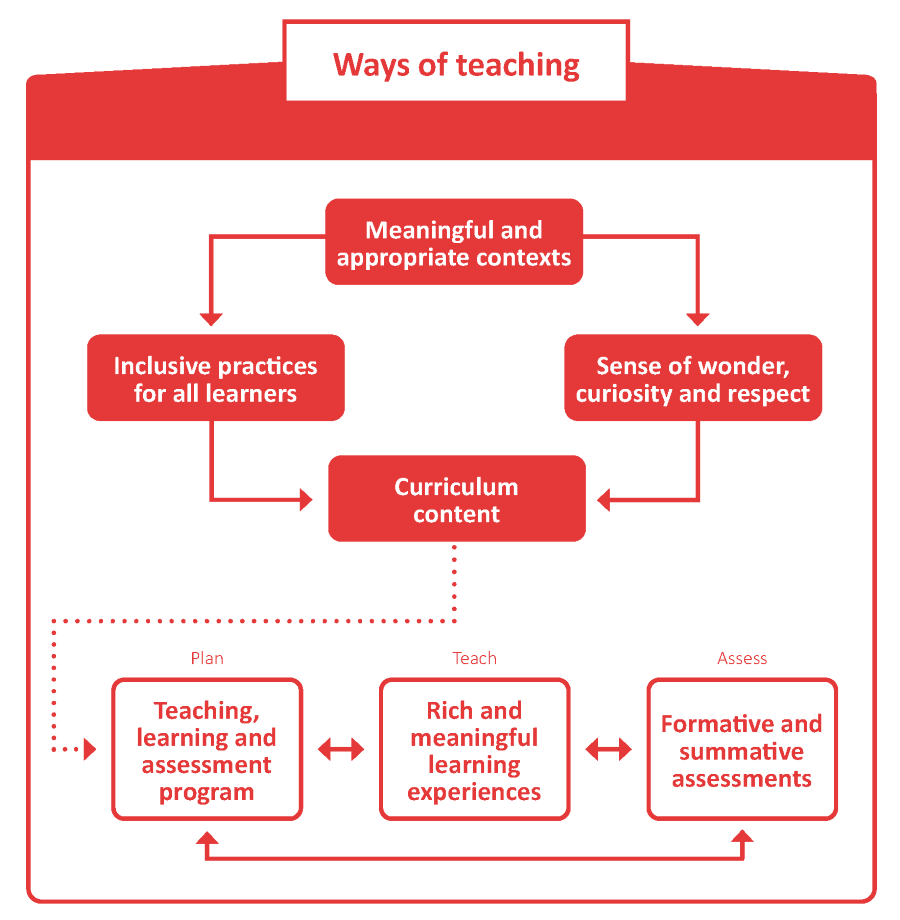
In the Humanities and Social Sciences curriculum, the key concepts, knowledge and understanding and skills within each subject are interrelated to inform and support each other. When developing teaching and learning programs, teachers combine these three aspects to create learning experiences. Civics and Citizenship, Economics and Business, Geography and History can be taught separately or through integrated programs created to link to more than one subject or to link to the content in other learning areas.
The Humanities and Social Sciences knowledge and understanding strand identifies key concepts that are the high-level ideas involved in teaching students to think from a humanities and social sciences perspective.
To engage students in Humanities and Social Sciences, teachers typically create learning experiences which:
- draw on students’ personal experiences and interests
- build, extend and challenge existing understandings and perceptions
- explore a range of viewpoints and different perspectives
- involve the past, present and future
- develop active and informed citizens
- use meaningful, real-world contexts, current events and issues to exemplify the content
- use a range of scales, from local area to regional, national and global areas
- engage students in problem-solving tasks and inquiry to develop evidence-based arguments, or proposals for actions or solutions to real-world challenges and opportunities
- involve students in learning outside the classroom through exposure to authentic experiences and making connections with local and wider communities
- develop skills, many of which are transferable to other learning areas and are valuable for students' future learning
- contribute to all the General Capabilities and the Cross-curriculum Priorities.
The figure below is a visual representation of ways of teaching Humanities and Social Sciences.