
The Humanities and Social Sciences learning area comprises four subjects. Content descriptions are organised into two interrelated strands:
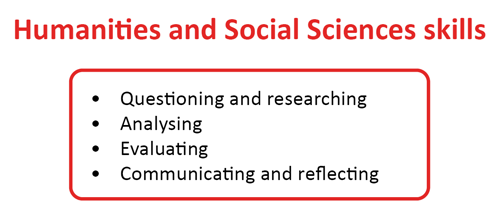
This strand includes a range of skills that are common to all four subjects. These are divided into: questioning and researching; analysing; evaluating; and communicating and reflecting. These skills can be taught discretely, in conjunction with the knowledge and understanding, through key concepts, or as part of an inquiry approach. Inquiry is not necessarily implemented in a linear fashion and not all investigations will involve all skills. Moreover, there may be different entry points where the skills are employed as part of an inquiry process. The Humanities and Social Sciences skills need to be explicitly taught and assessed. They are identified in the Achievement standard for each year group.
The figure below illustrates the organisation of the Humanities and Social Sciences skills.
Content is presented in year levels for the Knowledge and understanding strand:
- Civics and Citizenship in Years 3–10
- Economics and Business in Years 5–10
- Geography in Pre-primary–Year 10
- History in Pre-primary–Year 10.
Humanities and Social Sciences knowledge refers to the facts, principles, concepts, theories and models developed in each of the subjects. This knowledge is dynamic, and its interpretation can be contested, with opinions and conclusions supported by evidence and logical argument.
Humanities and Social Sciences understanding is the ability to see relationships between aspects of knowledge and construct explanatory frameworks to illustrate these relationships. It is also the ability to apply this knowledge to new situations or to solve new problems.
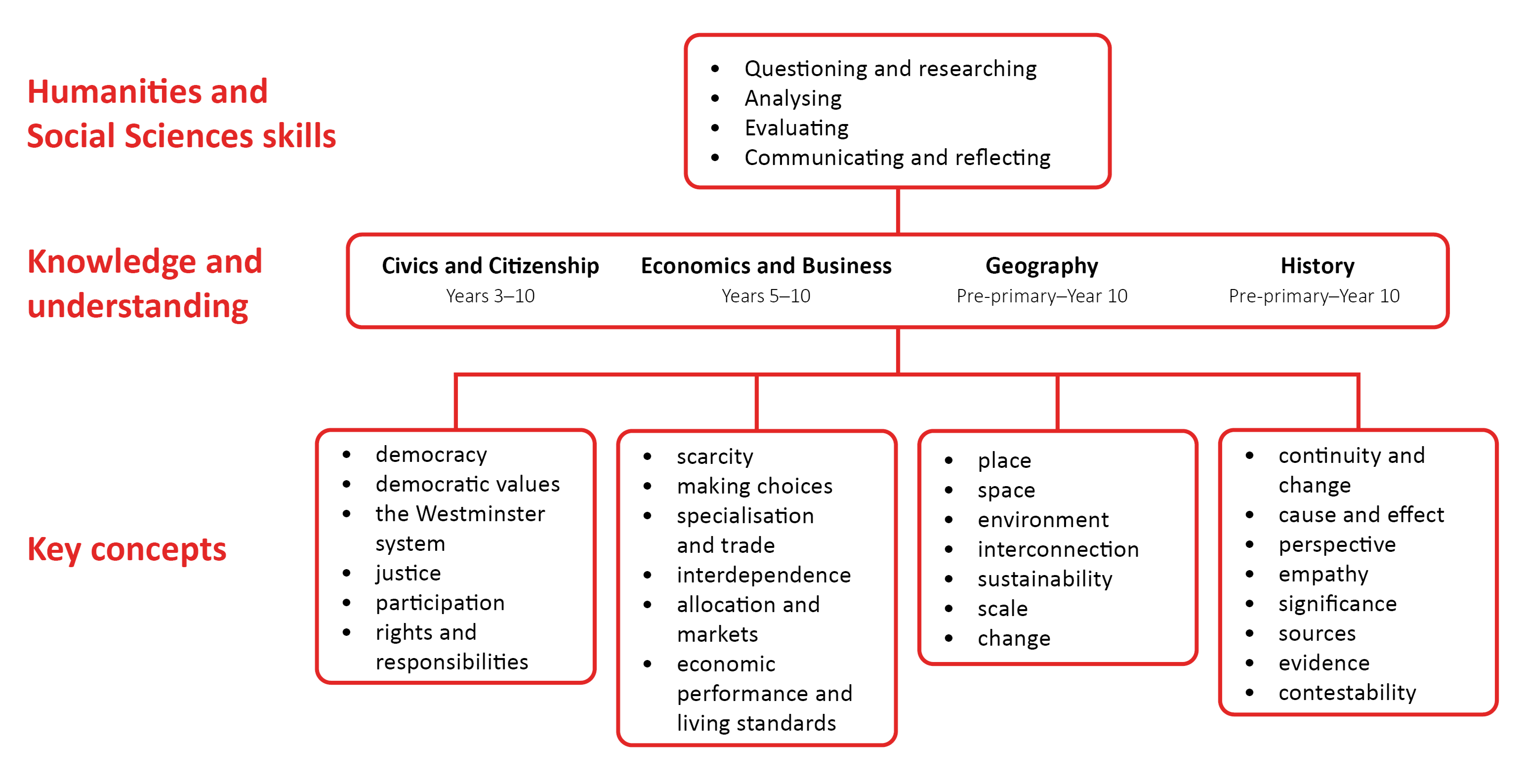
The figure below illustrates the organisation of the four subjects.

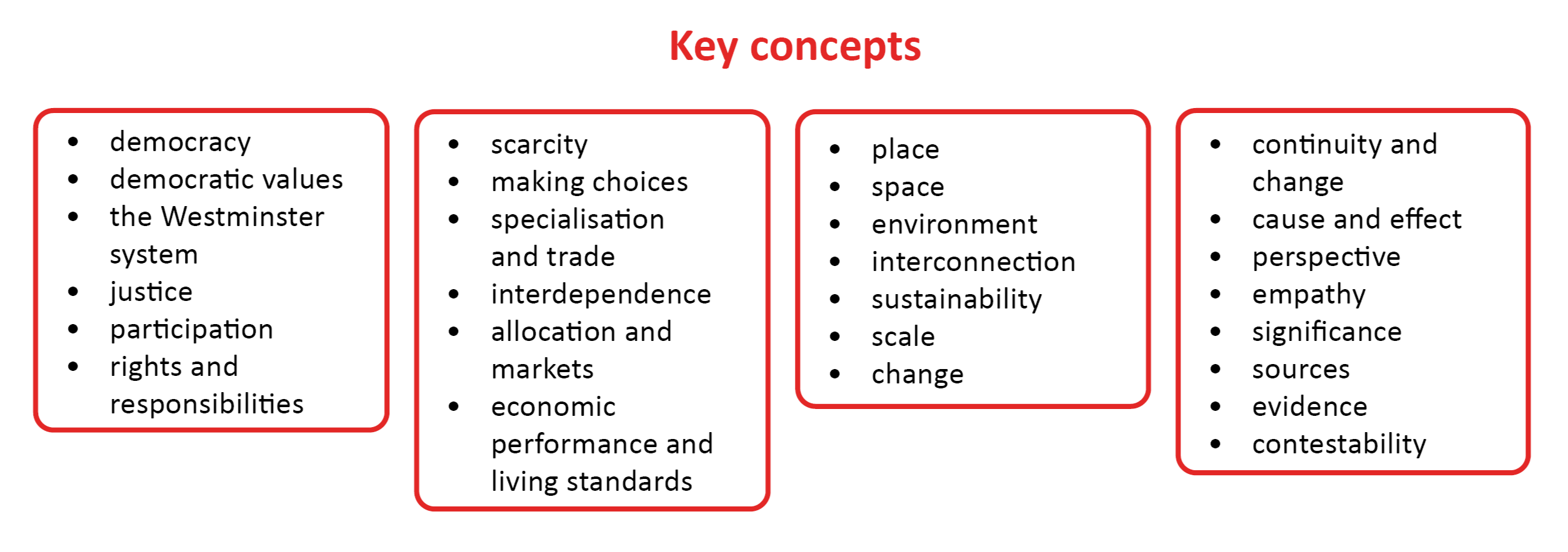
The key concepts in the Knowledge and understanding strand are the overarching ideas involved in teaching students to think from a Humanities and Social Sciences perspective. Organised under the four subjects, these concepts are:
- Civics and Citizenship – democracy, democratic values, the Westminster system, justice, participation, rights and responsibilities
- Economics and Business – scarcity, making choices, specialisation and trade, interdependence, allocation and markets, economic performance and living standards
- Geography – place, space, environment, interconnection, sustainability, scale, change
- History – evidence, sources, continuity and change, cause and effect, significance, perspectives, empathy, contestability.
The Humanities and Social Sciences key concepts are drawn from the Knowledge and understanding in the syllabus for each year. Teachers explicitly interrelate the Knowledge and understanding with the key concepts and the skills when planning for teaching, learning and assessment.
In each year the focus of the key concepts for each year level can be identified using the Achievement standard which either states the concept explicitly or implies it through the required Knowledge and understanding. Key concepts are revisited, strengthened and extended across the years, with the emphasis on particular concepts changing based on the Knowledge and understanding being developed.
The figure below illustrates the organisation of the key concepts for the learning area.
Relationship between the strands
The two strands are to be integrated in the development of a teaching and learning program. The Knowledge and understanding strand provides the content focus through which skills are developed. Following Pre-primary, the sequencing and description of the skills are in two-year bands (Years 1–2, 3–4, 5–6, 7–8, 9–10). This may assist in multi-age programming by providing a common skill focus for the teaching and learning of the Knowledge and understanding content.
The figure below illustrates the relationship between the strands.
Content descriptions
Content descriptions set out the knowledge, understanding and skills that teachers are expected to teach and students are expected to learn. They do not prescribe approaches to teaching. The content has been written to ensure that learning is appropriately ordered and that unnecessary repetition is avoided. However, a concept or skill introduced at one year level may be revisited, strengthened and extended at later year levels as needed.
The examples provide suggestions of ways to teach the content description and connect it to general capabilities and cross-curriculum priorities. Examples are optional and are not reflected in the Achievement standards.