Introduction
The Australian Curriculum: Turkish recognises that learners of Turkish in Australian schools have a range of cultural backgrounds and language experiences. Learners may have varying degrees of proficiency in Turkish as background-language learners or they may be learning Turkish as a second or additional language.
Rationale
Turkish is the official language of Türkiye and an official language of the Republic of Cyprus. In 1928 the founder of the Republic of Türkiye, Mustafa Kemal Ataturk, replaced the Ottoman alphabet with the Roman alphabet, a process which included modifications to the language.
The campaign of the Gallipoli Peninsula during World War I laid the foundations of what was later to become strong Australian–Turkish connections, characterised by economic and bilateral trade relationships, cultural exchanges and consular cooperation.
Turkish speakers have contributed to shaping multicultural Australia. Turkish has been taught in some Australian schools and tertiary institutions since the 1950s as well as in community-run organisations prior to this time. The influence of Turkish-speaking communities is evident in areas such as commerce, cuisine, religion and sport.
Turkish is the major member of the Turkic language family, within the Uralo-Altaic language group. It is a phonetic language and uses the Roman alphabet with additional diacritic marks, so speakers of English can recognise the script and attempt its pronunciation. Learning Turkish develops students’ understanding of the language and culture of Turkish-speaking communities. It also enhances students’ awareness of the nature of language learning and promotes an appreciation of diverse attitudes, beliefs and values. Knowledge of the Turkish language and culture enriches travel experiences and increases employment opportunities.
Structure
Turkish has been developed to cater for learners with different linguistic experiences, those with a background in Turkish as well as those learning Turkish as a second or additional language.
The Australian Curriculum: Turkish includes 2 sequences:
- Foundation to Year 10
- Years 7 to 10.
Teachers can use the curriculum to make appropriate adjustments to differentiate learning. Content elaborations provide differentiated examples of language use and contexts to assist teachers to meet the needs of a range of learners, including background-language learners and second-language learners.
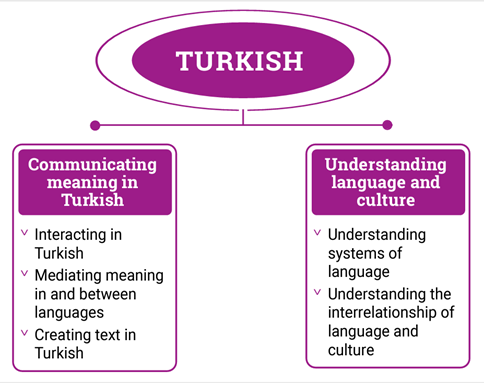
Content in Turkish is organised under 2 interrelated strands, each with a number of sub-strands. The strands and sub-strands are presented in Figure 2.
Strands
Strand: Communicating meaning in Turkish
This involves students learning to use language for communicative purposes in interpreting, creating and exchanging meaning. There are 3 sub-strands.
Interacting in Turkish
Exchanging ideas, opinions, experiences, thoughts and feelings in non-verbal, spoken and written interactions; participating in planning, negotiating, deciding and taking action.
Mediating meaning in and between languages
Obtaining, processing, interpreting and conveying information through a range of spoken, written and multimodal texts; moving between languages and cultures non-verbally, orally and in writing, recognising different interpretations.
Creating text in Turkish
Creating a range of spoken, written and multimodal texts for specific contexts, purposes and audiences.
Strand: Understanding language and culture
This involves students learning to analyse and understand language and culture as resources for interpreting and shaping meaning in intercultural exchange. There are 2 sub-strands.
Understanding systems of language
Understanding the linguistic features of Turkish, including sound, writing, grammatical and textual conventions.
Understanding the interrelationship of language and culture
Analysing and reflecting on the role of language and culture in shaping meaning and identity.