
Teaching mathematics is about making connections to existing knowledge to solve new problems both within and beyond mathematics. It is about showing students the power and beauty of mathematics and its relevance to the real world. Students must engage with both the content and the proficiencies in order to become flexible thinkers, creative and critical problem-solvers and mathematical thinkers now and into the future.
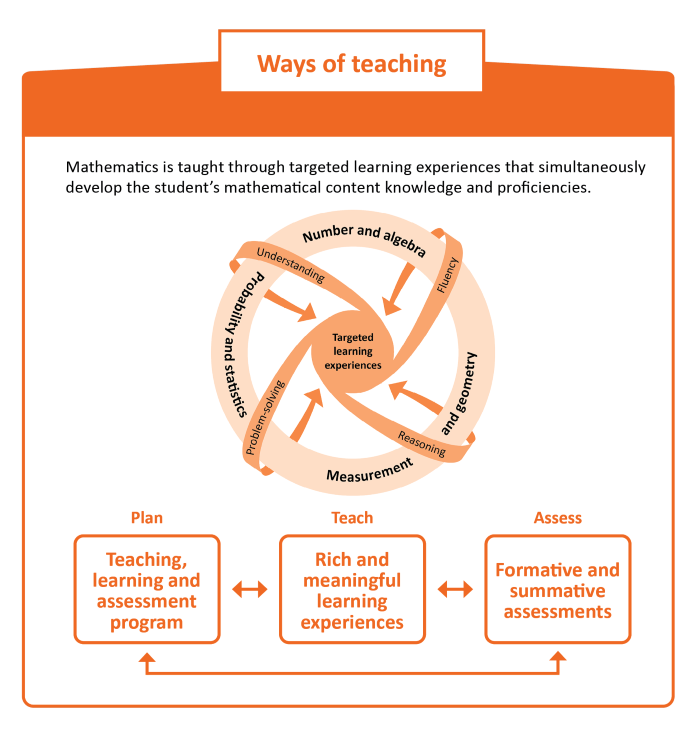
The Ways of teaching is illustrated below.
- major conceptual ideas from the current year syllabus are central to teacher programming
- all learning experiences within the program are purposeful, developmentally appropriate and support the long-term learning outcomes
- connections are made between the year level content and past and future learning
- prior knowledge is taken into account and is extended
- appropriate planned interventions support students’ progress towards the achievement standard where required
- transferable skills and thinking processes are developed through problem-solving
- activities are accessible and challenging to all students, providing opportunities for inclusivity and differentiation
- the literacy of mathematics (language, graphics, symbols) is developed
- appropriate materials, models, images or other representations are used purposefully to support students to move towards abstract ideas and create new knowledge and strategies
- opportunities are created to allow students to communicate and justify their strategies and solutions
- the relevant General Capabilities and the Cross-curriculum Priorities are incorporated to assist students to live and work successfully in the 21st century
- represent, solve or explore meaningful and unfamiliar problems and situations
- have time to think about and engage with problem situations, making sense of new concepts, ideas and experiences
- apply learning from one problem to other problems that involve different scenarios or contexts
- build and select from a repertoire of strategies to address learning tasks
- have purposeful opportunities to work independently and collaboratively
- answer focused questions and participate in guided mathematical conversations that deepen thinking, strengthen understanding and lead to generalisations
- comprehend and communicate ideas using appropriate mathematical language
- understand the purpose and intent of the learning activity and, if appropriate, its connection to the real world
- are accountable and responsible for their learning
- confidently seek and act upon constructive feedback
- reflect on learning experiences to consolidate learning
- feel safe to take risks in their learning, develop resilience and explore mathematical ideas with curiosity