
The Ways of teaching aims to support teachers with planning for curriculum delivery across the years of school, with the teaching in each year extending learning in previous years.
The Ways of teaching complements the principles of teaching and learning in the Western Australian Curriculum and Assessment Outline (https://k10outline.scsa.wa.edu.au). The principles focus on the provision of a school and class environment that is intellectually, socially and physically supportive of learning. The principles assist whole-school planning and individual classroom practice.
The Science curriculum develops an understanding of the nature of scientific inquiry and the ability to use a variety of scientific inquiry methods. It allows students to develop the scientific knowledge, understandings and skills to make informed decisions about contemporary issues at the individual, local, national and global levels.
Science teachers plan and develop engaging, relevant, inquiry-based lessons that integrate the two strands of Science understanding and Science inquiry, and provide a safe, positive and inclusive learning environment.
The Ways of teaching is illustrated below.
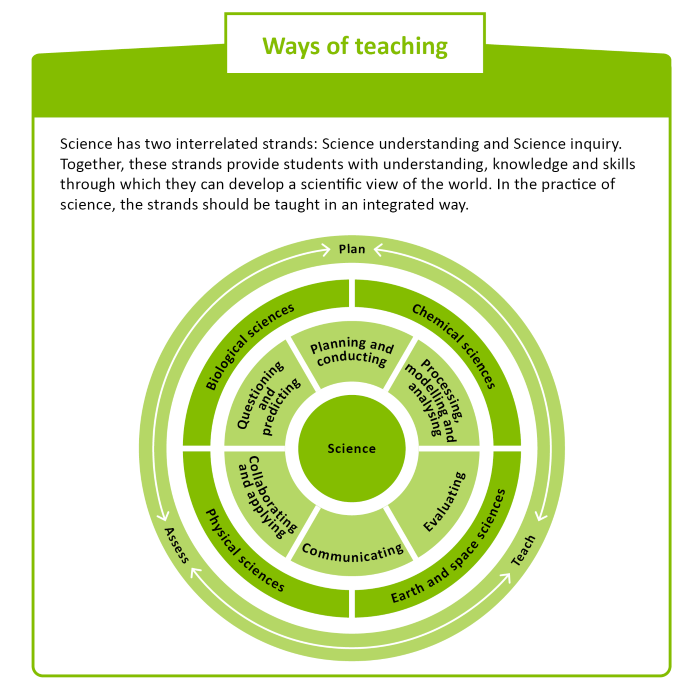
The Science understanding strand provides students with the science knowledge to explain and predict phenomena and apply that knowledge. Science knowledge refers to facts, concepts, principles, laws, theories and models that have been established over time.
The Science inquiry strand provides students with the skills to investigate ideas, develop explanations, solve problems, draw valid conclusions, evaluate claims and construct evidence-based arguments. The Science inquiry sub-strands form the steps in the science inquiry process. The science inquiry process is not cyclical or linear, it is a process with many entry and exit points.
Science inquiry learning experiences could combine all or some of the Science inquiry sub-strands through science investigations and practical activities.
- Science investigations are activities in which ideas, predictions or hypotheses are tested, and conclusions are drawn from the evidence collected. They can involve a variety of activities including experimental testing, fieldwork, conducting surveys, and using modelling and simulations. The choice of the approach taken will depend on the context and aims of the investigation.
- Practical activities can be used to explore phenomena and confirm science understandings. Practical activities also provide the opportunity for students to develop skills, such as the safe use of equipment, making observations and accurate measurements. They can also involve processing, analysing and interpreting evidence.
The following list provides examples of learning experiences. The list is not exhaustive, and teachers are encouraged to make professional decisions about which learning experiences best suit their classroom context.
Examples of learning experiences
- practical, hands-on activities
- science investigations
- play-based activities
- problem-solving
- group and class discussion
- constructing models
Examples of learning experiences
- predict-observe-explain
- concept cartoons
- graphic organisers
- developing and testing theories
Examples of learning experiences
- practical activities and investigations
- using play to explore nature and the natural environment
- group and class discussion
- using models and simulations
- demonstrations
- excursions/incursions
- engaging with others to co-construct learning
- multimedia
- role-play
- debates
- research
Examples of learning experiences
- differentiated activities
- modified programs for support and extension
- enrichment and challenge
- competitions
Examples of learning experiences
- data collection
- data processing
- simulations
- presentations
- web-based learning